Dr.Artis was so amazing. After going to two other podiatrists who gave me no support or hope, Dr. artis made me feel like there can be change for me. She was so patient, kind and informative. I’m actually excited to go back and get my results.

An ankle sprain occurs when the ligaments that support and stabilize the ankle are stretched beyond their normal range or torn due to sudden twisting, rolling, or impact injuries. Ligaments are strong bands of tissue that connect bones to each other and help maintain ankle stability. When these ligaments are overstretched during an injury, they lose their ability to function properly, leading to pain, swelling, instability, and difficulty walking.
Ankle sprains are one of the most common foot and ankle injuries and are frequently caused by falls, sports injuries, uneven surfaces, or twisting the ankle in an unusual way. Symptoms often occur immediately after the injury and may significantly interfere with daily activities if not treated properly. Prompt diagnosis and treatment are important to avoid long-term complications such as chronic ankle instability and recurrent sprains.
As soon as an ankle injury occurs, patients are encouraged to limit physical activity and avoid placing unnecessary pressure on the injured ankle. Early treatment helps reduce swelling, minimize pain, and support proper healing of the damaged ligaments. Depending on the severity of the sprain, treatment may include rest, ice therapy, compression, elevation, bracing, casting, orthotics, anti-inflammatory medications, physical therapy, and in severe or recurring cases, surgical ligament repair or stabilization procedures.
Our goal is to provide minimally invasive care whenever possible so patients can safely return to normal activities quickly and comfortably. Proper diagnosis is essential to determine the extent of ligament damage and rule out fractures or additional injuries. X-rays are commonly performed to evaluate the ankle and ensure the appropriate treatment plan is selected.
In more complex cases, advanced imaging such as MRI may be recommended to assess soft tissue damage and ligament integrity. In cases where symptoms persist despite conservative treatment or the ankle repeatedly becomes unstable, surgical repair or tightening of the ligaments may be necessary to restore ankle function and prevent future injuries.
Once swelling and pain improve, physical therapy helps strengthen weakened ligaments, improve balance and coordination, restore flexibility, and reduce the risk of future ankle injuries. Rehabilitation plays an important role in achieving a safe and complete recovery.

For patients with severe ligament tears, chronic instability, or repeated ankle sprains that do not improve with conservative treatment, surgery may be recommended to repair or tighten the damaged ligaments and restore ankle stability.
Immediate treatment following an ankle sprain often includes rest, ice application, compression, and elevation to help reduce swelling, inflammation, and pain while protecting the injured ligaments during the early healing phase.
Compression braces, casts, or walking boots may be used to stabilize the ankle and limit excessive movement while the ligaments heal properly. Immobilization helps protect the injured area and prevents further damage.
Anti-inflammatory medications such as ibuprofen may be recommended to reduce pain, swelling, and inflammation associated with ankle sprains and soft tissue injuries.
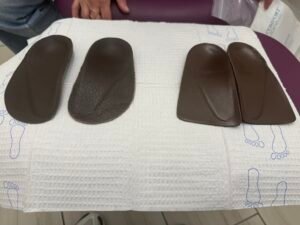
Custom orthotics or supportive footwear may be recommended to improve foot alignment, reduce strain on the ankle, and provide additional stability during recovery and daily activities.
Recovery time for an ankle sprain depends on the severity of the injury and how quickly treatment begins. Mild sprains may improve within a few weeks, while moderate to severe injuries can require a longer recovery period involving bracing, rehabilitation, and activity modification. Physical therapy is often introduced gradually as healing progresses to help restore normal function and mobility.
With prompt and appropriate treatment, most patients can recover successfully and avoid long-term complications. However, untreated or improperly healed ankle sprains can lead to chronic instability, repeated injuries, ongoing pain, and long-term damage to the ankle joint.
If you’re suffering from an ankle sprain, or any other foot/ankle condition, our New York foot doctors can help! Serving the Downtown and Midtown Manhattan areas of NYC, we help you get back to healthy and happy living. Call us at 917-398-3668 or book an appointment online.

Sometimes scar tissue builds up in a tendon and causes the tendon to lose its elasticity. At that point, chronic Achilles tendinitis can be treated by removing the scar tissue using a minimally invasive procedure like Tenex. This uses a wand that transmits ultrasonic energy to break through the scar tissue leaving healthy tissue behind. Downtime is minimal and return to normal activity is about a week.
Grab a resistance band (or even a stretchy t-shirt)! Place the band or shirt around the ball of your foot. Pull the two ends of the band or shirt towards you until you feel a nice stretch in the back of your leg. Hold this stretch for 30 seconds, and relax for 10 seconds. Repeat this 5-10 times for both legs!
Achilles tendonitis rarely requires surgery. However, if treatment is delayed or neglected, there could be further damage such as a tendon tear. This would require surgical repair, and although we can do this with minimally invasive techniques, it is better to prevent damage when possible. Don’t ignore your pain. See your podiatrist as soon as possible.
By accurately diagnosing, treating, and preventing lower leg, foot, and ankle conditions and ailments, we get you on your way back to healthy feet! We use conservative care and only activate surgeries when absolutely necessary. Here are some of the foot and ankle conditions we treat. Get that peace of mind, and reach out and book an appointment with us today!




TESTIMONIAL
Dr.Artis was so amazing. After going to two other podiatrists who gave me no support or hope, Dr. artis made me feel like there can be change for me. She was so patient, kind and informative. I’m actually excited to go back and get my results.
Everyone was super friendly. Doctor Rick’s explained everything thoroughly.
Dr Bell was incredibly thorough and personable. Gave me great information and useful information for my next steps. A great experience!
“Fast, professional, and very clean office. I was checked in and seen within 10 minutes of my scheduled time. Dr. Ricks was straight to the point but thorough. The front desk staff was also incredibly helpful.
All of the staff are super welcoming and professional! Bianca took excellent care in getting my X-rays. Dr. Ricks was thorough in explaining my diagnosis and next steps. Highly recommended!!
Well before I came in today to see Dr. Ricks my foot in pain was 9/10 and now I feel good 🙏🏿🤩 thanks
Our award-winning podiatrists at 4 Manhattan locations treat every condition — from heel pain to minimally invasive surgery — with care plans built around your lifestyle and budget.
Available at all 4 NYC locations
Walk in, walk out — no general anesthesia
We handle the billing so you don't have to
As seen in Forbes & InStyle Magazine