Dr.Artis was so amazing. After going to two other podiatrists who gave me no support or hope, Dr. artis made me feel like there can be change for me. She was so patient, kind and informative. I’m actually excited to go back and get my results.

Patients frequently use the terms “flat feet” and “fallen arches” as if they are the same thing and in casual language, they often are. But clinically, the distinction is important. Flat feet describes a structural condition in which the medial longitudinal arch is constitutionally low or absent, present since childhood or early adulthood as a stable characteristic of foot architecture. Fallen arches describes a change — the loss of an arch that was previously present which is almost always a sign of an active pathological process requiring prompt evaluation and treatment. At Healthy Feet Podiatry, our NYC podiatrists distinguish between these presentations on the first visit because the cause, the urgency, and the treatment approach differ fundamentally.
Flat feet (pes planus) describes a foot type characterized by a low or absent medial longitudinal arch that has been present, typically, since childhood. Flexible flat feet — the most common variant show a reconstituted arch when the foot is non-weight-bearing and collapse to a flat or near-flat profile under load; rigid flat feet show no arch in any position. Flat feet as a constitutional foot type are not inherently pathological many individuals with flat feet are entirely asymptomatic and require no treatment. Fallen arches describes the acquired loss of arch height in a foot that previously had a normal or near-normal arch this is adult-acquired flatfoot deformity, most commonly caused by progressive posterior tibial tendon dysfunction. Fallen arches represent an active, often progressive condition: the tendon degenerating, the spring ligament elongating, and the talonavicular joint subluxing gradually over months to years. The clinical urgency of fallen arches is substantially higher than that of constitutional flat feet because the window for conservative intervention closes as deformity advances.
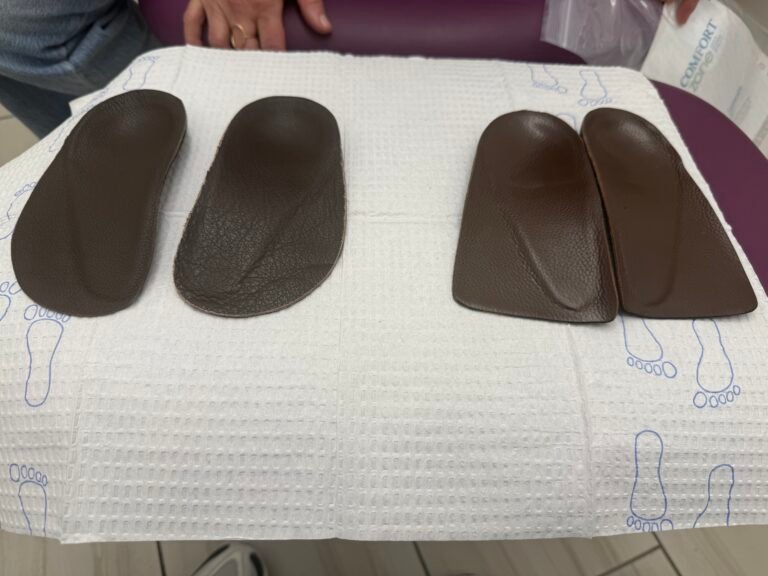
The treatment distinction between flat feet and fallen arches follows directly from the etiological difference. Constitutional flat feet that are symptomatic causing medial arch pain, plantar fasciitis, Achilles tendinopathy, or downstream knee and hip pain are managed with custom orthotics to support the arch and redistribute load, physical therapy targeting posterior tibial tendon and intrinsic foot muscle strengthening, and supportive footwear modification. The condition is stable and the goal is symptom management. Fallen arches adult-acquired flatfoot from posterior tibial tendon dysfunction require a staged treatment approach that begins urgently: immobilization or orthotics to offload the diseased tendon and prevent further collapse, physical therapy, and anti-inflammatory management at Stage I; aggressive orthotic control, activity modification, and surgical evaluation at Stage II; and surgical reconstruction for Stage III and beyond. Time matters in fallen arches in a way it does not in stable constitutional flat feet every month of unaddressed PTTD is a month of further tendon degeneration and deformity advancement.

TESTIMONIAL
Dr.Artis was so amazing. After going to two other podiatrists who gave me no support or hope, Dr. artis made me feel like there can be change for me. She was so patient, kind and informative. I’m actually excited to go back and get my results.
Everyone was super friendly. Doctor Rick’s explained everything thoroughly.
Dr Bell was incredibly thorough and personable. Gave me great information and useful information for my next steps. A great experience!
“Fast, professional, and very clean office. I was checked in and seen within 10 minutes of my scheduled time. Dr. Ricks was straight to the point but thorough. The front desk staff was also incredibly helpful.
All of the staff are super welcoming and professional! Bianca took excellent care in getting my X-rays. Dr. Ricks was thorough in explaining my diagnosis and next steps. Highly recommended!!
Well before I came in today to see Dr. Ricks my foot in pain was 9/10 and now I feel good 🙏🏿🤩 thanks
Behind every great care experience is a team that truly listens. Our doctors are committed to understanding your needs, delivering personalized treatment, and supporting you every step of your health journey.

Dr. Farah Alani is a New York City foot and ankle surgeon at To Healthy Feet Podiatry, a boutique podiatry practice located in the heart…

Dr. Alison Bell was born in Manhattan and is a Public Health graduate of Charles R. Drew University. She obtained her medical degree from Kent…

Dr. Roxann Clarke is a graduate of Hampton University in Virginia, where she obtained her Bachelor of Science in Biology and her Master of Science…

Dr. Ricks is a board-certified fellowship-trained podiatric surgeon committed to delivering top-tier foot and ankle care. From New Jersey, she a Bachelor’s in…

As the Chief Operating Officer of To Healthy Feet Podiatry, Tiffany provides leadership to ensure all administrative are producing optimal results. Dr….
Our award-winning podiatrists at 4 Manhattan locations treat every condition — from heel pain to minimally invasive surgery — with care plans built around your lifestyle and budget.
Available at all 4 NYC locations
Walk in, walk out — no general anesthesia
We handle the billing so you don't have to
As seen in Forbes & InStyle Magazine